Feature: Ko Chih-en's Sharp Debate Performance Earns Her the Title of 'War Goddess'; Whether Her Crossover Appeal Will Hold Remains to Be Tested

Taiwan's nine-in-one elections have entered their final stage.
Kuomintang Kaohsiung mayoral candidate Ko Chih-en's momentum has rebounded after the televised debate, with some supporters even calling her a 'female war goddess.' Blue camp figures say Ko's performance not only boosted supporters' morale but also attracted voters who previously paid no attention to the Kaohsiung race, producing a 'crossover' effect.
The debate was held last Friday (Oct. 30).
Ko went on the offensive, criticizing DPP candidate Lai Jui-lung for being nurtured by the party's New Tide faction and bluntly calling him a 'New Tide baby.' In her final 10-minute closing statement, she announced she was setting aside her prepared notes and, in response to Lai's claim that he would take up the 'fourth baton' of Kaohsiung city governance, criticized the DPP for treating Kaohsiung as its own 'exclusive preserve,' vowing to strike her opponent out.
The exchanges were subsequently edited into short videos and circulated on social platforms such as Facebook and Threads.
Taiwanese media, citing blue camp figures, reported that these videos broke through the political echo chamber and produced a crossover effect.
After the debate, Ko campaigned for votes at traditional markets and also felt that public reactions were more enthusiastic than before.
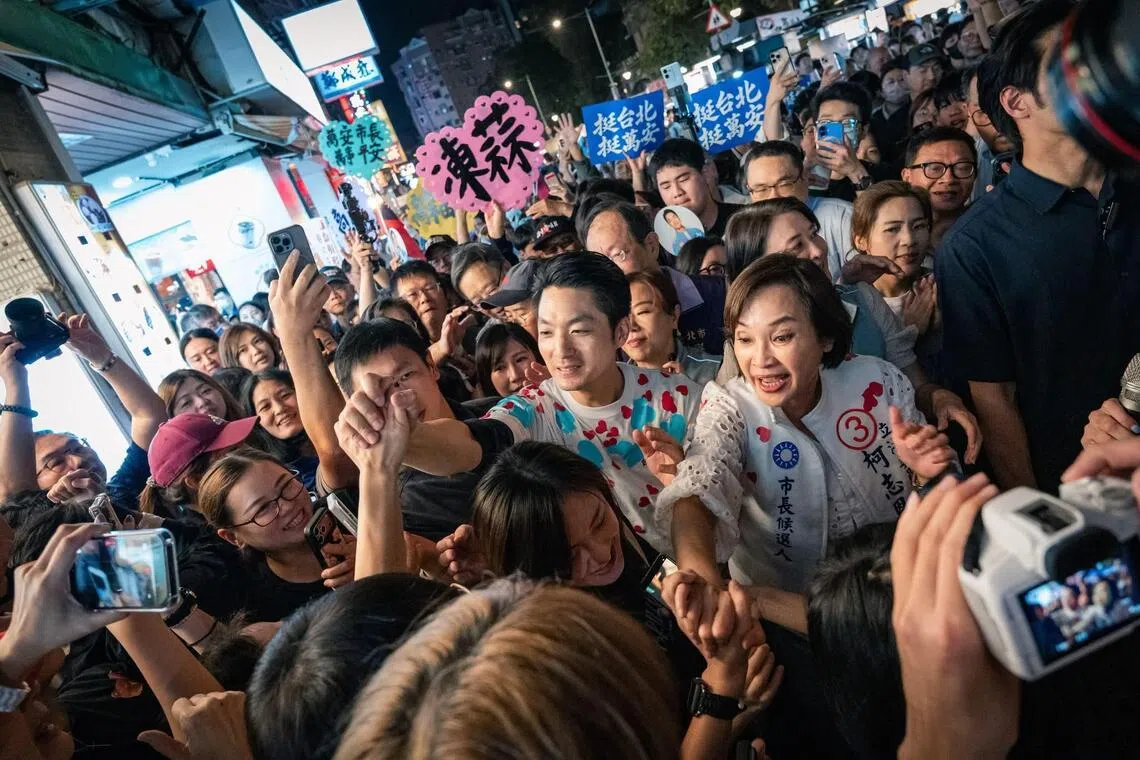
Ko's campaign office said that to sustain the spillover benefits of this crossover effect, she made a special trip north on Tuesday evening (Nov. 3) to join Taipei Mayor Chiang Wan-an, who is seeking re-election, in canvassing at Ningxia Night Market.
Supporters at the scene shouted 'Turn Kaohsiung around, Taipei will win,' and the two shook hands, took photos and signed autographs with members of the public along the way.
Scholars interviewed believe Ko's debate performance helped boost blue camp morale and drive campaign momentum, but whether this heat can further break through her original supporter base and translate into actual votes remains to be seen.
Liu Chia-wei, a professor in the Department of Public Administration and Policy at National Taipei University who watched the entire debate, said in an interview with Lianhe Zaobao that Ko was well prepared, attacked forcefully and performed calmly.
She noted in particular that Ko questioned Lai's relationship with photovoltaic industry operators, but Lai failed to respond adequately.
The two sides also clashed over issues including amendments to the Fiscal Revenue and Expenditure Allocation Act and party and factional interests, and there was almost no lull throughout the debate.
However, Liu Chia-wei noted that according to existing election research, candidate debates usually have only a limited actual impact on the race, as 'most people have already made up their minds,' and debates serve more to consolidate existing supporters rather than change voters' voting intentions.
Regarding the blue camp's claim that Ko successfully achieved a crossover effect, Liu Chia-wei said this is also a campaign strategy.
Ko's trip north to appear with Chiang Wan-an helps sustain the momentum after the debate and, through north-south linkage, creates an atmosphere of expanding support.
Green camp keeps things cool: Can the final 'Three Mountains' rally heat up the race?
Liu Chao-lung, an associate professor in the Department of Public Affairs and Civic Education at National Changhua University of Education, also believes Ko's momentum rebounded after the debate, but there has long been a certain gap between the blue and green basic support bases in Kaohsiung.
Even when Han Kuo-yu set off the 'Han wave' and won the Kaohsiung mayoralty in 2018, the defeated DPP candidate Chen Chi-mai still received 44.8% of the vote, showing that the green camp has a solid support base.
Two Kaohsiung mayoral election polls published on Monday (Nov. 2) by United Daily News and Fengcan Media both showed Lai Jui-lung leading Ko Chih-en, with gaps of seven and 20.4 percentage points respectively.
The United Daily News poll's survey period spanned the Oct. 30 televised debate, while the Fengcan Media poll was completed before the debate.
Liu Chao-lung believes Ko has continued to cultivate Kaohsiung over the past few years and performed quite well in the 2022 mayoral election.
However, the DPP has adopted a 'cold war' strategy in Kaohsiung to avoid heating up election issues, because 'the colder the race, the more favorable it is for the incumbent.' In the 2022 nine-in-one elections, Ko Chih-en challenged the DPP's Chen Chi-mai, who was seeking re-election, in Kaohsiung and received 40.16% of the vote, losing to Chen's 58.1%.
Ko will hold her third and final 'Three Mountains' rally in Qishan on Saturday (Nov. 7), and Chiang Wan-an is expected to travel south to appear on stage.
When Han Kuo-yu ran for Kaohsiung mayor, he also held large rallies successively in Fengshan, Qishan and Gangshan, ultimately breaking the DPP's long-standing rule in Kaohsiung.
Liu Chao-lung explained that Fengshan and Gangshan were home to military academies and military dependents' villages and are traditionally blue-leaning areas, while Qishan has a certain proportion of Hakka voters and strong clan organizations.
Therefore, if the 'Three Mountains' mobilization succeeds, it will help lift the blue camp's momentum.
Whether Saturday's final Qishan rally can carry forward the post-debate heat and turn online buzz into physical mobilization will be a key point to watch next.
Comments (0)