Gao Quanqing on the Role of the Singapore Chinese Chamber of Commerce and Industry: A Bridge Between Singapore and China, Upholding "Harmony in Diversity"

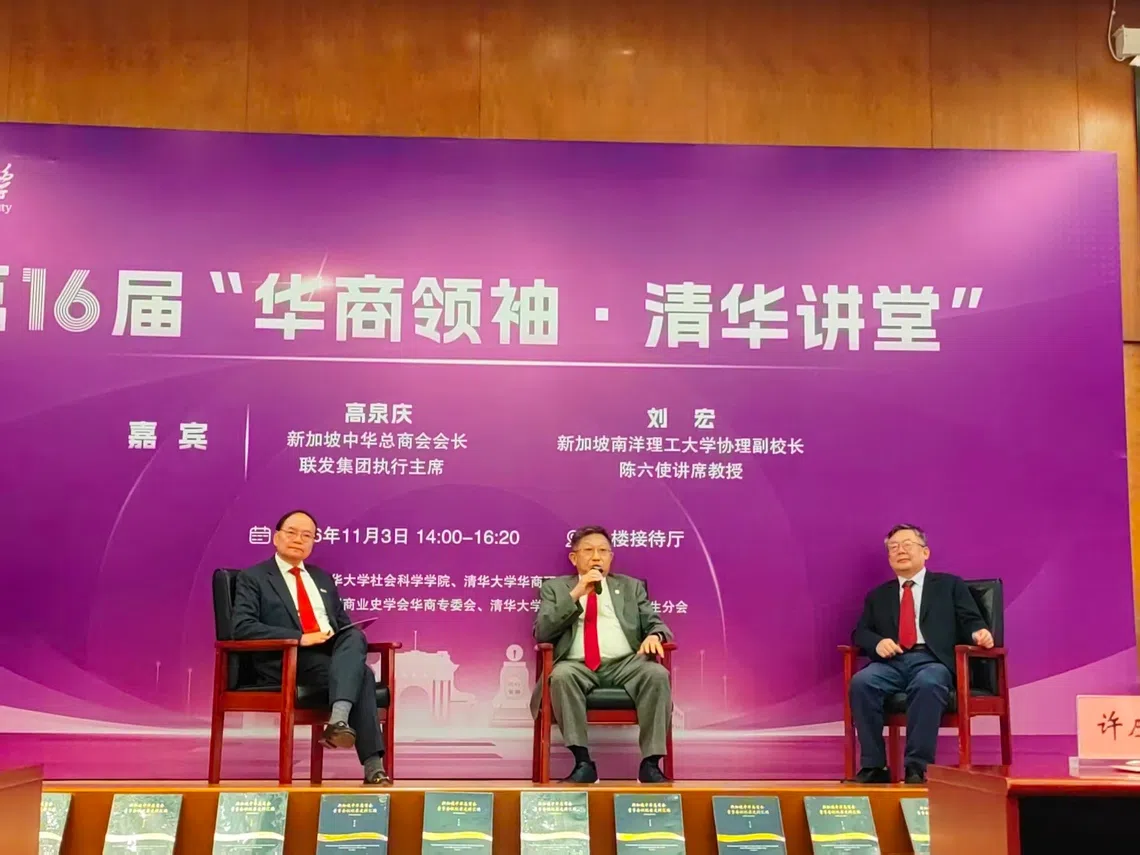
Gao Quanqing, President of the Singapore Chinese Chamber of Commerce and Industry (SCCCI) and Executive Chairman of Lianfa Group, said that the SCCCI serves as a bridge in promoting Singapore-China economic and trade cooperation.
He also emphasized that the Chamber upholds the spirit of "harmony in diversity" when promoting exchanges and cooperation among Chinese businessmen worldwide.
On Tuesday (November 3), Gao Quanqing delivered a speech titled "The Chinese Business Spirit of the 'Little Red Dot'" at the 16th "Chinese Business Leaders · Tsinghua Lecture Hall" held at Tsinghua University, elaborating on the SCCCI's 120-year history of safeguarding the rights and interests of Chinese businessmen, promoting Singapore-China economic and trade cooperation, and passing on the Chinese business spirit.
Founded in 1906, the SCCCI was established primarily to meet the needs of mutual assistance and trade among overseas Chinese in Southeast Asia.
It is Singapore's oldest cross-clan Chinese business leadership organization, currently comprising more than 150 member trade associations and chambers of commerce, covering nearly 100,000 Singaporean enterprises.
Gao Quanqing said that during the British colonial era, most overseas Chinese in Singapore still had their hearts set on their homeland in China.
Business leaders including Mr.
Tan Kah Kee generously donated to China to build schools and support the war effort and national salvation.
After Singapore's independence in 1965, Singaporean Chinese shifted their mindset from "fallen leaves returning to their roots" to "putting down roots locally." Gao Quanqing noted that Lee Kuan Yew mentioned at the Second World Chinese Entrepreneurs Convention in 1993 that with the rise of the "Greater China" concept, economic exchanges among mainland China, Hong Kong, Taiwan, and overseas Chinese were expanding.
If economic ties were viewed as political unity, or as individual Chinese businessmen or Chinese communities jointly achieving economic progress through some form of alliance, this could exacerbate social and ethnic tensions in some Southeast Asian countries.
Therefore, when the SCCCI promotes exchanges and cooperation among Chinese businessmen worldwide, it has always emphasized "harmony in diversity," advocating that Chinese businessmen from all countries, while prioritizing loyalty to their own national interests, leverage the cohesive power of Chinese culture to achieve mutual benefit and win-win cooperation in various fields, so that all ethnic groups in all countries can benefit from economic development.
Speaking of the deep friendship and economic and trade cooperation between Singapore and China built on trust, Gao Quanqing said that the SCCCI has played an active bridging role.
The SCCCI currently has five representative offices in China.
In 2008, it initiated the establishment of "Business China." It also organizes multiple China business delegations each year to connect Singaporean and Chinese enterprises.
Next year, it will hold the fifth International Industry Cooperation Conference after the pandemic to promote exchanges and cooperation in industrial and supply chains.
In addition, the SCCCI holds the Singapore-China Business Forum annually to discuss major development trends between the two countries.
Liu Hong, Associate Vice President of Nanyang Technological University and Tan Lark Sye Chair Professor, noted in his speech titled "The Institutionalization and Contemporary Transformation of Overseas Chinese Business Networks" on the same day that cultural commonality serves as a lubricant for Chinese enterprises entering Southeast Asian markets, but is not a necessary prerequisite for cooperation.
He said that when Chinese enterprises go global and cooperate with local Chinese businessmen, they need to achieve a "one plus one is greater than two" cooperative effect through complementary interests in specific fields, rather than simply relying on cultural ties.
He also noted that Chinese enterprises have been going global for more than 20 years, but still face pain points and difficulties, including differences in cultural integration, lack of effective management tools, and inflexibility in supply chains.
For overseas Chinese, this presents a new opportunity—"how to align with the trend of Chinese enterprise internationalization in the process of building their own advantages, and fill gaps or help Chinese enterprises solve these pain points and difficulties." However, besides opportunities, there is often another side to the story.
During his research in Malaysia, Liu Hong found that local Chinese enterprises were not particularly welcoming to the arrival of some Chinese enterprises, because "what Chinese enterprises may bring is more competition.
If some Chinese enterprises engage in price wars after going abroad, this puts great pressure on local Chinese businesses."
Comments (0)