Zhao Qizheng calls for finding a group of young Americans who truly understand China to help warm China-US relations

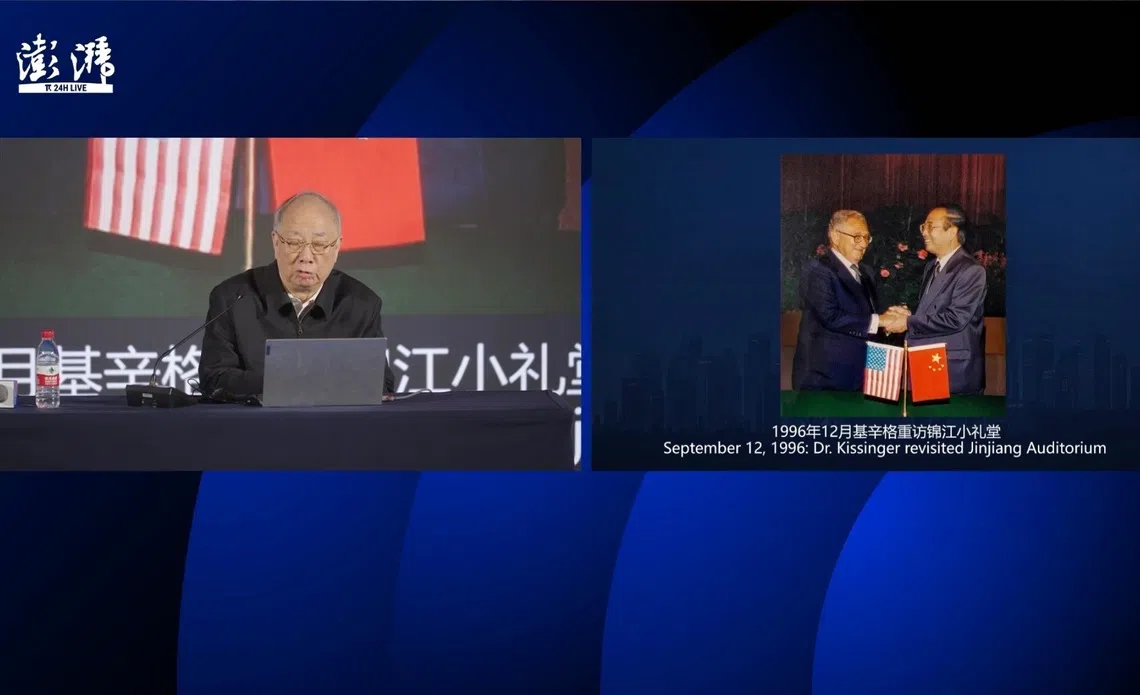
Zhao Qizheng, former director of China's State Council Information Office, said that compared with the 1980s and 1990s, China-US relations since Trump's first term have been "relatively cold." Citing former US Secretary of State Henry Kissinger as an example, he called for finding a group of young-generation Americans who truly understand China to "warm China-US relations back up." Zhao Qizheng attended the "China-US Intergenerational Dialogue 2026 — In Search of 'Kissinger'" event on Friday (October 30), co-hosted by The Paper and the Shanghai Institutes for International Studies, where he shared stories of his interactions with Kissinger and reviewed the changes in China-US relations.
Zhao Qizheng, 86, previously served as a member of the Standing Committee of the Shanghai Municipal Committee of the Communist Party of China, vice mayor of Shanghai, and director of the Pudong New Area Administration Committee, participating in the early work of Pudong's development and opening-up. From 1998 to 2005, he served as director of the State Council Information Office, promoting reform of the spokesperson system and advocating openness of government information and respect for the public's right to know. He also previously served as a member of the Standing Committee of the Chinese People's Political Consultative Conference National Committee and director of its Foreign Affairs Committee.
Zhao Qizheng met with Kissinger more than 10 times, and Kissinger once called him "Mr. Pudong."
Discussing the evolution of China-US relations, Zhao Qizheng said that in the 1980s and 1990s, relations between the two countries were generally improving and exchanges were frequent, but after US President Trump's first term and former President Biden's administration, China-US relations encountered setbacks, with many confrontational remarks, and tariff frictions also cast a shadow over how the two countries got along, with fewer exchanges between the two sides.
In his view, in the future China and the United States cannot pin their hopes on the emergence of a single "Kissinger"-style figure, but should instead seek a group of "Kissingers" — a group of young Americans who truly understand China — to help warm relations between the two countries.
The Chinese and US heads of state achieved historic mutual visits within half a year this year, and both sides agreed to build "a constructive strategic stability relationship based on respect, fairness and reciprocity." Before the end of this year, the two heads of state are expected to meet again during the APEC Economic Leaders' Meeting and the G20 Summit.
This China-US intergenerational dialogue was held in the small auditorium of the Jinjiang Hotel in Shanghai. In 1972, when then US President Nixon visited China, China and the United States issued their first Joint Communiqué — the famous Shanghai Communiqué — here.
According to a report by The Paper, during the main dialogue session of the event, Zhu Feng, executive director of the China Center for Collaborative Studies of the South China Sea at Nanjing University, noted that Kissinger's efforts to bring China and the United States closer at the time had a specific Cold War geopolitical background, and that China and the United States had common external security concerns.
But Zhu Feng noted that it is now difficult to replicate the old model of forming strategic unity through a "common enemy," so while welcoming the emergence of new "Kissingers," it is necessary to understand Kissinger's legacy in a different way.
He said the core of Kissinger's legacy lies first in valuing China's millennia-long history and civilization and understanding the deep civilizational foundations behind China's rise; second, in "mutual respect that is shared and rich in humanistic meaning."
Zhu Feng believes that rather than simply waiting for a landmark figure to appear, it is more important to rely on pragmatism to create new momentum for bilateral relations, while also valuing people-to-people and cultural exchanges as a key bridge.
He also expressed concern about the current downward trend in youth study-abroad exchanges between China and the United States, believing that the continued weakening of mutual perceptions at the youth level will damage the foundation of bilateral relations in the long term, and that all parties need to make sustained efforts to stabilize and broaden channels for people-to-people and cultural exchanges.
On how the next generation of China-US "bridge builders" can help the two countries move toward each other, Thomas Fingar, a professor at Stanford University and former US assistant secretary of state, said at the same dialogue that bridge builders need the courage to communicate candidly, and that the goal of communication is not to argue over right and wrong but to identify obstacles and solve problems together.
He believes that the most important inspiration Kissinger left to later generations is precisely this spirit of facing differences directly and engaging in pragmatic dialogue.
Comments (0)