

How AI Is Reshaping Automotive Electronic Software Architecture Design? A Comprehensive Analysis of the Software Architecture Design Agent

3 months ago
For teams working on automotive electronic software architecture, the biggest fear is not the architecture design itself, but that once the design is done, the documentation has just begun.
A hundred-page requirements document, a set of customer-specific templates (Word + Excel), plus ASPICE SWE.3, functional safety ASIL allocation, layered architecture (application layer → service layer → abstraction layer → driver layer) and other specification requirements—architects need to break down requirements one by one, draw layered diagrams, define interface matrices, write dynamic sequences, and mark requirement traceability.
One round of writing for one version of requirements, another round when requirements change, always playing catch-up.
Software architecture documentation is becoming an increasingly prominent bottleneck in the automotive electronics R&D process.
It is slow because of the many dimensions of layered design, complex interface relationships, and strict specification constraints; it is difficult because coverage completeness, requirement traceability, and review consistency are hard to guarantee solely by human experience over the long term.
The Software Architecture Design Agent aims to compress architecture documentation from "weeks" to "hours," freeing architecture teams from repetitive organization so they can spend time on more important architectural decisions, design reviews, and solution optimization.
1. Pain Points: Why Manual Architecture Documentation Is So Hard
Let's break it down. The difficulty of manually writing automotive electronic software architecture documentation centers on five things.
First, too many layers, manual enumeration is impractical.
A complete middleware architecture involves four layers: application layer, service layer, abstraction layer, and driver layer. Each layer has multiple sub-architectures, dozens of components, and hundreds of software units.
Each component requires defining functional descriptions, interface lists, ASIL levels, development types, and dependencies—no matter how carefully done manually, it's hard to ensure nothing is missed.
Second, too many templates, each customer has different requirements.
Different OEMs have vastly different architecture template formats:
- Some require Word specification documents + Excel interface matrices;
- Others require PlantUML architecture diagrams + Markdown text.
Templates have dozens of placeholders like <XX> and <XXX>, and replacing them one by one is time-consuming and error-prone.
Not to mention that when the customer updates the template, the format adjustments have to be done all over again.
Third, too many standards, relying on memory is unreliable.
ASPICE SWE.3 has clear review element requirements (O-1~O-9) for software detailed design, and functional safety standards have hard constraints on ASIL allocation and isolation.
Which check items need to be covered, which anti-patterns need to be avoided—relying on long-term human experience maintenance is risky.
Fourth, when requirements change, documentation must be reworked.
After a requirements document update, the architecture design must be adjusted synchronously.
But there is often a lack of clear correlation between "which requirements changed" and "which components are affected."
Missed changes won't immediately report errors; they only silently leave risks in subsequent development.
More troublesome is when comparing architecture differences between two versions—manually comparing interface signals, dependencies, and resource allocations item by item is a huge workload and prone to omissions.
Fifth, high review costs, and the later the stage, the easier it is to deviate.
Whether an architecture design is reasonable usually requires simultaneous cross-referencing of requirements, interfaces, standards, and historical experience.
With dozens of components, you can still review them one by one; with hundreds, it easily turns from "serious review" into "format checking."
Worse still, the rectification of review comments often lacks closure—whether changes were made, what was changed, and whether new issues were introduced after changes—tracking costs are high.
The first three points drag down efficiency; the last two bury quality risks.
And the fourth point—document synchronization and version difference analysis after requirement changes—is precisely the part that automotive electronics architecture, a field with strong traceability, cares about most and is hardest to cover reliably by human effort.
2. Scenario 1: Forward Design of System Software Architecture—From a Requirements Document to a Complete Specification
This is the most core scenario and best demonstrates the "efficiency gap."
Take a typical cockpit domain controller project as an example:
The requirements document is 80+ pages, covering multiple functional domains such as power management, communication management, diagnostic management, and state management.
To manually write an architecture specification, the architect needs to break down requirements one by one, layer them according to the four-layer architecture, define sub-architectures and components, write functional descriptions and interface definitions one by one, draw architecture diagrams and sequence diagrams, fill in the interface matrix, and establish requirement traceability.
For a skilled architect to complete the above work, two to four weeks is normal.
Past: Weeks of manual writing
Architects had to analyze requirements one by one, design layers, write documents, draw diagrams, and proofread.
If requirements changed once, they had to re-investigate the impact scope.
Now: Generation in hours
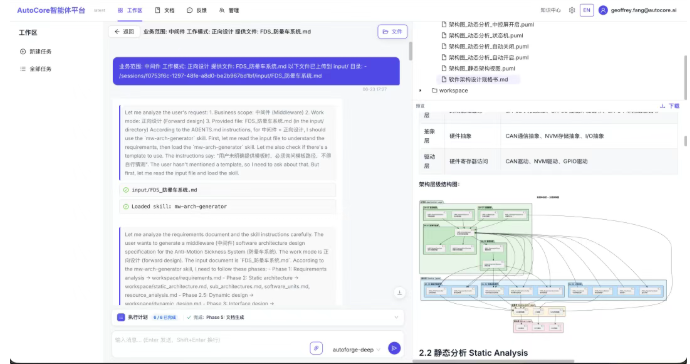
Architects only need to submit the requirements document and the customer's template. The Agent automatically completes requirement analysis, layered design, interface definition, dynamic scenario design, and document generation, ultimately delivering a complete Word specification, Excel interface matrix, and PlantUML architecture diagram.
Architects no longer start from a blank document but review, revise, and confirm based on the generated results.
But more important than "speed" is the effect:
- More complete: Full coverage of requirement-to-architecture traceability; dynamic scenarios and resource analysis are no longer "written only when remembered"
- More consistent: Unified structure, numbering, and terminology style across the entire document; the same delivery standards are maintained across different projects
- More standardized: Automatically aligns with ASPICE SWE.3 document organization requirements; clear layered isolation; no basic issues like cross-layer calls
- Better traceability: The mapping from each requirement to each architectural element is clear at a glance; when requirements change, it's quick to identify which components need adjustment
3. Scenario 2: BSW Basic Software Architecture—AUTOSAR Module-Level Design
If middleware architecture focuses on "layered components," BSW (Basic Software) architecture focuses on AUTOSAR CP module-level and API function-level design.
This is also a frequent pain point scenario.
A BSW architecture specification needs to list each API function provided by each underlying module clearly—function name, parameter types and meanings, return value, call relationships—and also supplement task cycles, interrupt vectors, and compilation environment (OS and compiler version).
This information is scattered across code, data sheets, and engineers' minds. Manually organizing it into text is almost as tedious as debugging just to align function signatures.
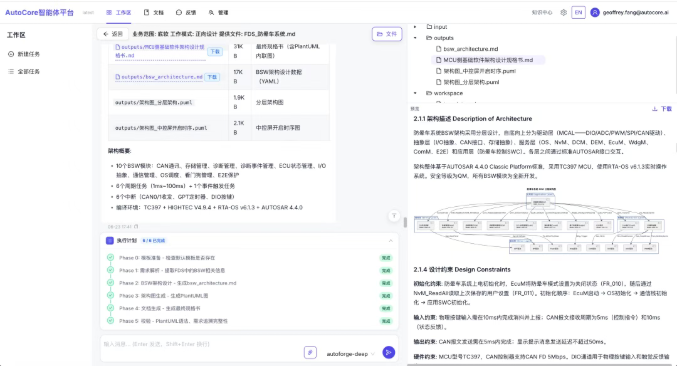
The Agent's approach is to start directly from the requirements document, automatically identify the BSW modules involved in the project, and generate a complete BSW architecture specification according to the template.
The output includes:
- API function-level definitions for each module
- Task and interrupt configuration
- Compilation environment description
- Requirement-to-architecture traceability table
The effect is straightforward:
Previously, function signatures had to be filled in by browsing code and verbal confirmation; now they are output structurally at once, giving the team a "base document" to reference collectively.
When adding a new module, it's no longer "ask Lao Li how it was designed back then," but look at the specification.
4. Scenario 3: Customer Template Adaptation—No More Fear of Template Changes
Customer template changes are another "nightmare" for architects.
Different OEMs and different project stages have vastly different template formats.
Every template update means a heavy round of format adjustments.
But this problem is essentially not an "architecture design" problem but a "data and format coupling" problem.
Architecture data—component definitions, interface matrices, dynamic scenarios—does not change just because the template version changes; what really consumes time is re-laying out and proofreading the same data according to the new template.
The Agent's approach is to decouple these two things:
The data produced by architecture design remains structured, while template adaptation automatically completes the "data filling into format" step.
Whether it's a Word specification or an Excel interface matrix, the Agent can automatically identify the template's chapter structure and placeholders, accurately fill the architecture data into the corresponding positions, while preserving the template's original fonts, paragraphs, and table styles.
This brings three core advantages:
First, zero rework for template updates.
When the customer changes the template, the architect does not need to re-layout chapter by chapter.
Simply resubmit the new template, and the Agent runs through the process to output a specification in the new format—architecture data unchanged, format automatically aligned.
Second, one set of data, multiple format outputs.
The same set of architecture design data can simultaneously output Word according to OEM A's template, Excel according to OEM B's template, and Markdown according to an internal review template.
No longer need to maintain multiple sets of documents for different delivery targets.
Third, content and format maintained separately.
Architects focus on design content; format issues like table column counts, chapter order, and style details are automatically handled by the Agent.
Filling instructions in the template are automatically removed, placeholders are automatically replaced, and diagrams are automatically embedded—no manual line-by-line checking and patching required.
Final Thoughts
The goal of the Software Architecture Design Agent has never been to replace architects.
It aims to replace the repetitive, mechanical, and most patience-consuming parts of architecture documentation—breaking down requirements, filling templates, drawing diagrams, marking traceability, and performing checks;
And leave to humans those decisions that truly require experience and judgment:
- Architecture solution selection
- Design trade-off evaluation
- Review quality control
Especially in a field like automotive electronic software architecture, which is strongly standardized, layered, and traceability-driven, its greatest value is not just "writing faster," but making architecture documentation more stable, more consistent, and easier to integrate into the team's engineering closed loop:
- Every document is traceable
- Every change is trackable
- Every review is evidence-based
When architects are no longer trapped by blank documents and customer templates, the truly important work has just begun.
